

Research Starts Before the IPO – Why a private-market lens has become essential to active public-equity investing
Click here to download a PDF version of the this post.
By the time an IPO is filed, the race to understand the company is often already crowded. The prospectus is public, the roadshow has begun and investors are working from largely the same set of information on a timetable set by the underwriters. For a public equity manager, particularly one focused on small and mid-sized companies, that is increasingly late in the life of a business to begin the research process.
Many of the companies that will shape tomorrow’s smaller-cap markets are already institutional quality businesses today. They have raised multiple rounds of private capital, built meaningful revenue bases, hired experienced management teams and established positions in their industries, all before becoming publicly traded. University of Florida research illustrates just how much this has changed. The median market capitalization of companies going public, measured at the first close, was approximately $1.56 billion in 2025, compared with $751 million in 2024 and $267 million in 2023. The average in 2025 was approximately $4.91 billion. In other words, waiting until a company enters the public market can mean waiting until a meaningful portion of its evolution has already taken place.
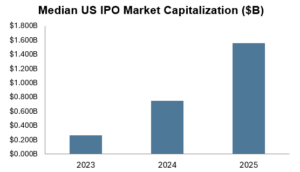
Source: Jay R. Ritter, University of Florida, Initial Public Offerings Updated Statistics
For Hood River, understanding companies before they become public is not some new initiative built around the recent rise in prevalence of private markets. It is an extension of a research process the team has implemented for years. Through long-standing relationships with investment banks, management teams and other industry participants, Hood River has regularly met with private companies as they mature toward the public market arena. The objective has always been broader than gaining access to an investment. It is about understanding businesses, industries and competitive dynamics as early and as thoroughly as possible. That work has become increasingly valuable as companies are staying private longer.
These conversations can provide valuable industry context that can be compared against public filings, management discussions, channel work and other research. A private competitor may offer a different perspective on customer behavior. A supplier may help explain how purchasing patterns are evolving. A new entrant may reveal where established companies are vulnerable or where barriers to entry are stronger than they appear. Those insights can sharpen the research on companies Hood River already owns just as much as they can inform an investment in the private company itself.
We believe this presents a meaningful risk for public equity managers that ignore the private market. They are not only missing potential pre-IPO investment opportunities. They may be missing part of the industry they are responsible for understanding.
Private companies can acquire customers, hire talent, change pricing, introduce new technology and reshape supply chains years before those changes become obvious in the financial statements of their publicly traded competitors. For an active manager trying to identify information gaps between what the market expects and what is happening on the ground within an industry, leaving private companies out of the research universe can lead to a significant blind spot.
Hood River’s track record in the public markets makes this work particularly relevant. The team approaches private companies through the same lens it has long applied to public equities: understanding the business, challenging management’s assumptions, speaking with participants around the company, building forecasts and determining what expectations are already reflected in the valuation. The security may be different, but the fundamental research questions are largely the same.
In some cases, that work also creates an opportunity to invest prior to an IPO. Banking relationships can provide Hood River with access to select late-stage financing rounds. These investments may be offered at a negotiated valuation below the level a company ultimately hopes to achieve in the public market. That potential discount compensates investors for accepting additional risks, including illiquidity, more limited disclosure and the possibility that an IPO is delayed or does not occur. It is not a substitute for fundamental research. It is valuable only when the underlying business and the terms of the investment justify taking those risks.
The relationship can be valuable to the company as well. A late-stage private business preparing to enter the public market often wants more than capital. Management teams want to understand how institutional investors will evaluate their business, which metrics will receive the most attention and which parts of the story may require additional explanation. Hood River can bring that perspective from years of investing in small and mid-sized public companies while maintaining its independence as an investor.
Additionally, there can also be signaling value in having an established long-only equity manager on the shareholder list ahead of an offering. Hood River’s participation demonstrates that an experienced public market investor has spent time evaluating the business and is willing to commit capital prior to the IPO. As other institutional investors conduct their own due diligence, the presence of a long-only manager can provide an additional point of institutional context. For management, it can also create continuity with a shareholder that understands the company privately and will potentially remain an investor once it becomes public. Finally, management typically prefers to transition its shareholder base early to traditional public market investors as the company enters its next stage of growth. This can help offset potential selling and liquidity pressure from early investors and shareholders. If the decision is made to invest at the IPO, the existing relationship with management and demonstrated interest in the company can also lead to an allocation of shares.
Just as importantly, doing the work early improves Hood River’s options even when the team decides not to make a private investment. When an IPO eventually arrives, the decision is no longer being made from a standing start. The team may already know management, understand the competitive landscape, have historical forecasts against which to judge execution and know which questions remain unanswered. Instead of spending a compressed IPO process learning the basics of the business, the research can focus on what has changed, and what still needs to be proven.
That experience has been built over time. As of June 30, 2026, Hood River had participated in over 90 unique IPO investments and evaluated more than 600 IPO opportunities over the preceding five years. Across different market environments, the team has seen businesses transition successfully from private to public ownership as well as companies whose expectations proved too optimistic. That history provides a useful framework for evaluating whether a business is ready for the public market, where forecasts deserve greater scrutiny and when patience may be more valuable than participation.
The growth of the IPO market makes that experience particularly relevant today. Renaissance Capital counted 202 US IPOs with at least $50 million of market capitalization in 2025, raising $44.0 billion, compared with 150 IPOs in 2024 and 109 in 2023. Yet outcomes varied considerably. Only 71 offerings raised at least $100 million, still below the prior decade’s average of 95. Larger 2025 IPOs returned 21% from their offer prices on average, compared with 1% for the full group. A healthier IPO environment creates more opportunities, but it does not make every new issue attractive. If anything, a wider range of outcomes increases the value of knowing the business before the offering begins.
This is why Hood River views public and private market research as parts of the same process rather than separate disciplines. Conversations with private companies can improve the team’s understanding of existing public holdings and their industries. Public market experience provides a framework for testing the forecasts and valuations of private businesses. Banking and industry relationships can create access to companies and late-stage financing, while the research process determines which opportunities deserve capital. Each part reinforces the other.
The goal remains the same as it has always been: To understand important companies earlier, develop a wholistic view of the industries in which they compete and be prepared to invest when the balance of risk and potential return is compelling. The growth of private markets has not required Hood River to reinvent its investment process. We believe it has made a time-tested part of that process more valuable to our investors.
Sources: University of Florida, Initial Public Offerings Updated Statistics; Renaissance Capital, US IPO Market 2025 Annual Review
Information provided has been gathered from sources that are considered to be reliable, however its accuracy cannot be guaranteed. This white paper is for informational purposes only and does not constitute an offer to sell or a solicitation of an offer to buy any securities.
